Replit Agent 4 Review: 9 Smart Ways It Can Speed Up Building and Earning in India
Replit Agent 4 Review starts with a simple question: are we finally at the point where one person can sit down with a rough idea in the morning and end the day with a website, an app prototype, a workable design system, and even a pitch deck? That sounds dramatic, but that is exactly why this…
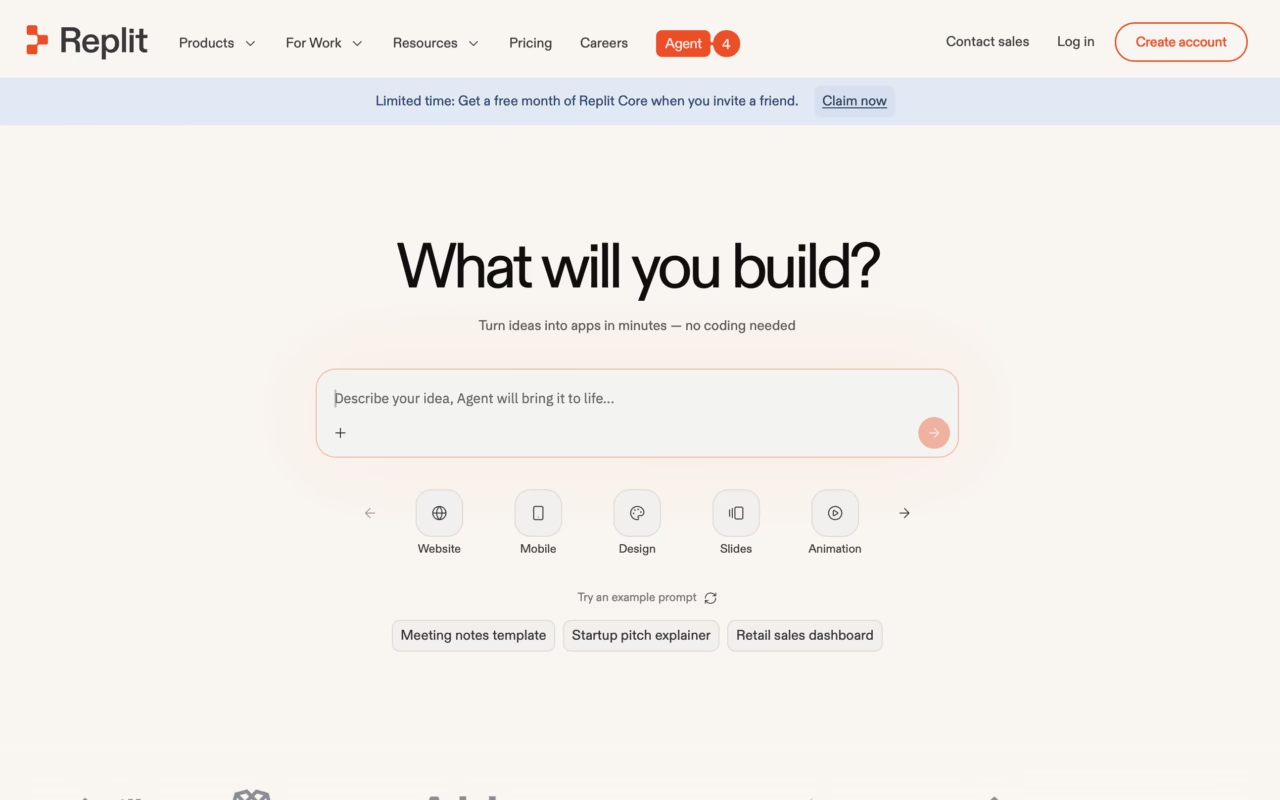
Replit Agent 4 Review starts with a simple question: are we finally at the point where one person can sit down with a rough idea in the morning and end the day with a website, an app prototype, a workable design system, and even a pitch deck?
That sounds dramatic, but that is exactly why this kind of demo gets attention. In the example behind this discussion, one side follows the old route: hire a project manager, bring in developers, bring in a designer, bring in testing, wait for handoffs, and spend real money before anything is visible. The other side opens an AI workflow and tries to get the website, app screens, design changes, and investor materials moving from one place.
What makes this interesting is not the hype. It is the shift in workflow.
For years, building a digital product meant jumping between tools. You would sketch in one place, design in another, write the code somewhere else, wait for feedback in another app, then create slides separately when you needed to pitch the idea. The promise here is that the workflow becomes tighter: think, prompt, design, edit, build, publish, and package the idea faster.
That does not mean the human stops mattering. It means the bottlenecks change.
And that is the real point of this Replit Agent 4 Review. The big story is not “AI has ended software work.” The real story is that product building is getting faster, cheaper, and more accessible for people who know how to direct the tool properly.
Why This Replit Agent 4 Review Matters for India
For builders in India, speed changes everything.
A lot of people here do not start with a big team. They start with an idea, some savings, maybe a part-time coder, maybe a designer they know, maybe a founder friend who is trying to make a deck look better at midnight. The problem is usually not creativity. The problem is time, execution, and cost.
That is why tools like this matter.
If you are a freelancer, small agency owner, founder, product-minded developer, or even someone who wants to test startup ideas without burning lakhs before validation, a workflow like this can be genuinely useful. You can move from idea to mockup faster. You can show something instead of only explaining it. You can reduce dead time between thinking and shipping.
In the finance app example, the AI is shown creating a clean dashboard, adjusting for Indian users with INR instead of dollars, editing UI text live, pushing design changes, building a web interface, and creating a companion app flow in parallel. That matters because it reflects how founders actually work: one minute they care about visuals, the next minute they care about usability, then they need a pitch deck because an investor meeting appears out of nowhere.
A tool that handles multiple outputs in one flow is not just convenient. It is commercially useful.
What the Demo Gets Right
The strongest thing in this Replit Agent 4 Review is not that the AI can produce code. Plenty of tools can throw code at you now. The more important detail is that it can sit in the middle of a broader build process.
That means a few things stand out.
First, the design is not locked away as a static file. You can tweak text, colors, visual tone, and basic layout decisions while the rest of the work is progressing. That reduces one of the most annoying parts of product work: waiting for one small change to pass through three people.
Second, the outputs are not limited to one surface. Website, mobile app, deck, and other assets can be developed in the same project context. That matters because real-world product work is rarely one file and one screen. It is a bundle of assets that all need to tell the same story.
Third, the experience becomes more prompt-driven and iterative. That sounds obvious, but in practice it changes who can build. A person who understands users, business goals, workflows, copy, and product positioning suddenly becomes far more powerful, even if they are not a top-tier frontend engineer.
This is where the tool starts feeling less like a code generator and more like a fast execution layer.
What It Still Cannot Do on Its Own
A balanced Replit Agent 4 Review has to say this clearly: speed is not the same as judgment.
Yes, AI can generate a dashboard.
Yes, it can produce a usable layout quickly.
Yes, it can draft working flows faster than many teams can manually get through first pass.
But there are still gaps, and those gaps are important.
It does not automatically understand business reality. It does not truly know what your users fear, what they ignore, what makes them trust a product, or what edge case will break your onboarding. It can suggest structure, but it does not carry real product responsibility unless a human is guiding it.
It also does not magically solve deep system design. Scalable architecture, security, data structure decisions, payments, permissioning, compliance, and long-term maintainability still need experienced thinking. That is where senior product engineers, architects, and thoughtful designers still matter a lot.
The best way to look at this is simple: AI helps you move faster through obvious work, first drafts, interface scaffolding, packaging, and momentum. But it still needs a human to decide what is worth building, what should be shipped, and what could damage the product later.
That is why the smartest takeaway is not “AI replaces everyone.” It is closer to this: AI replaces friction first.
The Real Job Question Everyone Is Asking
Every serious Replit Agent 4 Review ends up facing the same question: will this kill jobs?
The honest answer is more boring than the fear-based version.
It will absolutely squeeze routine, low-level, repetitive work. Basic UI assembly, boilerplate code, simple flows, rough landing pages, and early-stage prototype packaging are becoming easier to automate. Junior people who only know how to execute instructions without context are under pressure. That part is real.
But the more thoughtful conclusion is that the market is shifting toward people who can combine tools with judgment.
A strong designer who understands user behavior becomes more valuable, not less, because they can now explore more directions faster. A developer who can think beyond code and ship a real product becomes more valuable, because AI helps them compress execution time. A founder who can communicate clearly suddenly has more leverage, because they can turn rough ideas into visible artifacts without waiting forever.
The people most at risk are the ones stuck doing narrow, replaceable tasks with no product sense attached.
The people who win are the ones who can say:
- this is the problem
- this is the user
- this is the right flow
- this is what should not be automated blindly
- this is how we take the first version to market
That is why I would not treat this as a threat-only story. I would treat it as a sorting mechanism. It rewards people who can think clearly and ship intelligently.
How to Make Money From This in India
This is the part many people care about most, and rightly so.
A practical Replit Agent 4 Review should not stop at “cool tool.” It should answer the obvious next question: how do you actually make money from it?
The first path is prototype services for startups. A lot of founders do not need a perfect product on day one. They need something they can show. That means you can offer a package that includes a landing page, an app mockup, a clickable web version, and a basic pitch deck. For many early founders, that is more useful than raw code because it helps them validate faster.
The second path is pitch-deck plus demo packaging. Many people can describe an idea badly. Very few can turn it into something visual that feels investable. If you can use AI tools to create a polished deck, a believable product preview, and a simple product story, you can charge for that combination. In India, this is useful for startup founders, agency owners, consultants, college founders, D2C operators, and people preparing for incubators.
The third path is MVP building for local businesses. Clinics, coaching brands, real estate operators, finance consultants, gyms, salons, and niche service businesses often need simple internal tools or customer-facing apps. They do not always need a giant custom software team at the beginning. They need an appointment flow, dashboard, lead tracker, membership system, or analytics panel. If you can package these fast, there is money in it.
The fourth path is landing pages for high-ticket offers. A lot of consultants and online businesses make money from one strong page, one strong offer, and one clean conversion flow. You can use AI to build fast drafts, improve the design, test variations, and deliver pages faster than traditional workflows.
The fifth path is design-to-demo retainers. Instead of selling only one-off projects, you can become the person a founder calls every time they need a new screen, a revised feature flow, a new deck for a meeting, or a visual mockup for a new direction. That becomes recurring work.
The sixth path is micro-SaaS validation. You can use this kind of workflow to build small tools yourself: calculators, planners, CRM-lite dashboards, lead-gen tools, niche admin panels, client portals, or industry-specific mini products. You do not need to fully overbuild them. You need to test whether people care, then improve what gets traction.
The seventh path is AI-assisted product consulting. This is less about selling code and more about selling clarity. You help founders structure the idea, design the first version, shape the flow, create a visual prototype, and package the idea into something fundable or sellable.
That is where the real earning upside sits. Not in typing prompts for fun. In using the speed advantage to help people move from vague idea to visible product.
A Simple Business Model Around This
If I were starting from scratch in India, I would keep the model simple.
I would offer three packages.
Package 1: Startup Prototype Pack
A clean landing page, basic dashboard screens, a mobile preview, and a short pitch deck.
Package 2: Local Business App Mockup Pack
A basic customer flow, admin view, branding cleanup, and one clear use case like appointments, tracking, or subscriptions.
Package 3: Founder Validation Pack
A clickable MVP, revised UI, investor deck, and one round of feedback changes.
This works because most early clients do not buy code first. They buy momentum.
They buy:
- speed
- clarity
- presentation
- early validation
- something they can show their team, users, or investors
That is exactly where AI-assisted build tools become commercially useful.
A Realistic Workflow That Actually Works
A lot of people make the mistake of opening the tool and immediately asking for a complete app. That is the fastest way to get a messy result.
A smarter workflow looks like this.
Start with the business problem. Who is the product for? What exactly is being solved? What is the first useful action the user should be able to take?
Then define the first version. Not the dream version. The first version.
After that, prompt the design clearly. Tone, device, audience, brand feel, country context, and important screens all matter. If you are building for Indian users, say that. If you want INR, say that. If you want a lighter tone instead of a shiny fintech look copied from US apps, say that too.
Then use the AI for first-pass execution:
- dashboard
- onboarding
- landing page
- app flow
- deck structure
After that, you step in as the product thinker:
- remove weak sections
- simplify the user path
- correct awkward copy
- fix cultural mismatch
- improve visual hierarchy
- challenge unnecessary features
This is the real pattern. AI drafts. Human sharpens.
And that is why the strongest people in this new workflow are not the people with the fanciest prompts. They are the people with the clearest judgment.
Where Replit Agent 4 Looks Most Useful
This Replit Agent 4 Review feels strongest in a few situations.
It looks very useful for:
- early startup prototypes
- product concept testing
- founder demos
- internal tools
- landing pages
- investor decks tied to a real product concept
- fast iteration when one person is doing multiple roles
It looks less convincing as a full replacement for:
- serious large-scale architecture work
- mature enterprise product systems
- high-risk security-heavy apps
- deep UX research
- long-term maintainability decisions made without review
That does not make it weak. It just makes it real.
Mistakes to Avoid
The easiest way to waste a tool like this is to confuse output with product quality.
A polished screen is not proof of a good product.
A fast deck is not proof of a good business.
A working prototype is not proof of market demand.
The second mistake is selling AI-generated work as if no review is needed. That is dangerous. If you are taking money from clients, you need to review every flow, every page, every button, every logic step, and every important line of copy.
The third mistake is building too much too early. People get excited because the speed feels addictive. Suddenly they are building website, app, admin panel, dashboard, CRM, investor deck, onboarding, referral loop, and analytics all at once. That usually makes the product weaker, not better.
The smartest move is still the oldest one: start with the smallest version that clearly proves something.
Useful Resources
Here are clean external links you can use in the article:
- Replit Agent 4
- Replit Design Canvas
- Replit Web Apps
- Replit Slide Decks
- Replit Projects
- Startup India
Books Worth Checking on Amazon India
These are clean Amazon India links:
- The Lean Startup by Eric Ries
- The Mom Test by Rob Fitzpatrick
- Sprint by Jake Knapp
- Hooked by Nir Eyal
- Zero to One by Peter Thiel
Final Thoughts
My final take in this Replit Agent 4 Review is simple.
This kind of tool is not magic, but it is not a toy either.
If you are expecting it to replace product judgment, deep UX understanding, strong architecture, and business thinking, you will be disappointed. But if you treat it as a serious execution multiplier, it becomes very powerful. It helps you move from idea to visible output much faster. It helps small teams look bigger. It helps solo builders act with more leverage. It helps freelancers package more value.
And most importantly, it changes how quickly you can test whether an idea deserves more effort.
That is the real win.
Not that the AI can generate a screen.
But that it can help you reach the moment of truth faster.
If you are a builder in India, that matters a lot.
Because in the early stage, speed is not just convenience.
Sometimes, speed is the business model.
Affiliate Disclosure
Some product links in a published version of this article may be monetized links. That means a small commission may be earned at no extra cost to the buyer. It helps support the time spent researching, testing, and writing.
Disclaimer
This article is for educational and informational purposes only. It is not investment advice, legal advice, startup funding advice, or a guarantee of business results. AI tools can speed up design and prototyping, but every output should still be reviewed for quality, accuracy, security, and product fit before client use or launch.
Platform Note
No single article can guarantee AdSense approval, Google Discover traffic, rankings, revenue, or product success. Those outcomes depend on overall site quality, originality, compliance, usefulness, trust signals, and execution.