2026 Banking Changes in India: 7 Important Updates to Avoid Surprise Charges
2026 Banking Changes in India: 8 Crucial Updates That Could Cost You Money 2026 banking changes in India are not just another round of small banking updates. For regular account holders, salaried people, traders, and anyone who still treats cash and compliance casually, this year brings a few changes that are easy to ignore but expensive…
2026 Banking Changes in India: 8 Crucial Updates That Could Cost You Money
2026 banking changes in India are not just another round of small banking updates. For regular account holders, salaried people, traders, and anyone who still treats cash and compliance casually, this year brings a few changes that are easy to ignore but expensive to miss.
That is exactly why this article matters.
A lot of people are still operating on old assumptions. They think UPI-based ATM cash withdrawal is somehow separate from regular ATM usage. They think cash reporting only matters if one giant transaction happens at once. They think zero-balance accounts are either useless or fully free in every possible way. They think digital fraud rules will somehow protect them even if they report late. And they think social-media finance claims are close enough to the truth to repeat without checking.
That mindset can create real problems.
This piece takes a calmer route. Instead of repeating every viral finance reel or dramatic WhatsApp claim, it focuses on what actually matters for ordinary banking in India, what is worth taking seriously, and how you should think about these changes if you want fewer surprises and better money discipline.
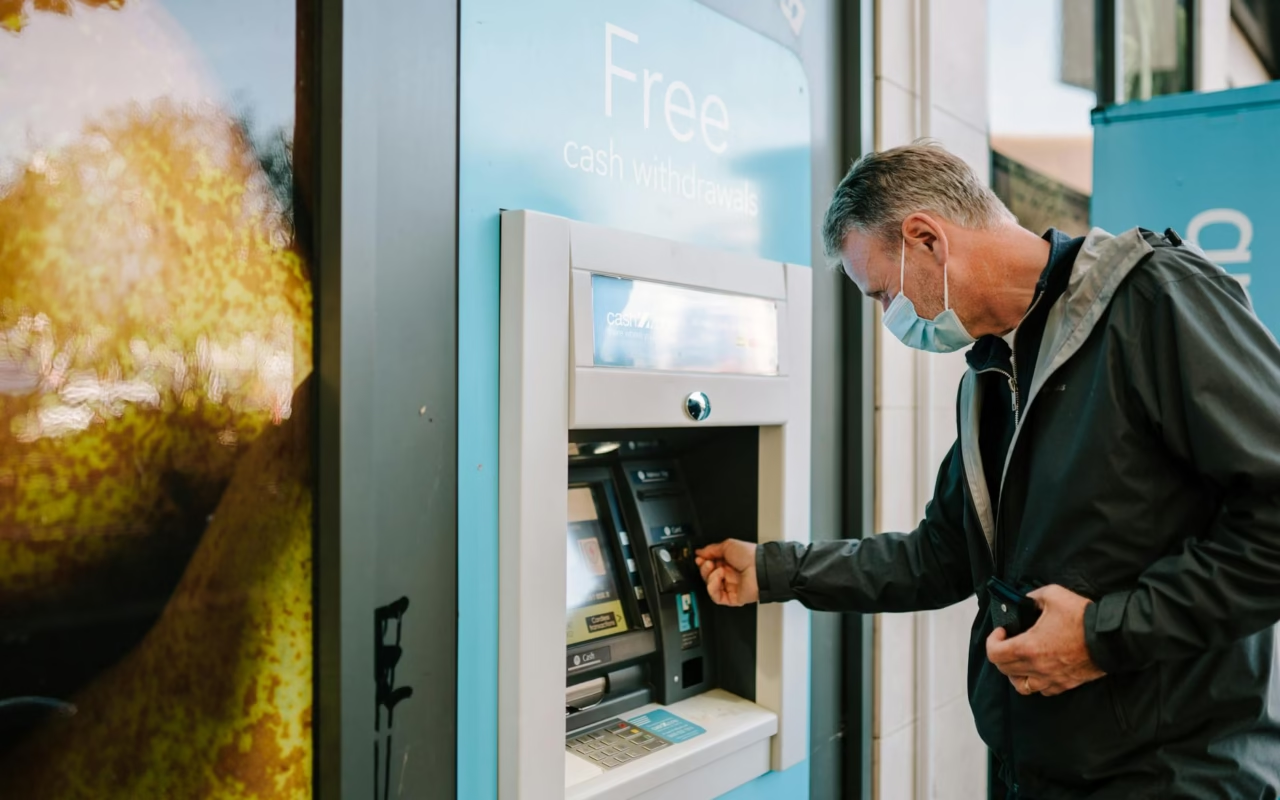
1) 2026 banking changes in India now make UPI ATM cash withdrawals more important to track
One of the most practical updates is around UPI-based ATM cash withdrawal.
A lot of people had started assuming that scanning a QR code at an ATM to withdraw cash was somehow outside the normal ATM free-withdrawal structure. That assumption now looks risky.
HDFC Bank has clearly stated that, effective 1 April 2026, UPI cash withdrawals at ATMs and CRMs will be counted as part of the monthly free ATM transaction limit. That means card-based ATM cash withdrawal and UPI-based ATM cash withdrawal are not necessarily two separate free buckets anymore. This is a very practical change because it affects how people casually use cash. (HDFC ATM page)
Let us make that real.
If your account allows a limited number of free ATM cash withdrawals every month, and you use some through your debit card and some through a UPI QR at the ATM, those may now be counted together depending on the bank policy. Once that free limit is over, the extra transactions can attract charges.
RBI’s ATM framework still matters here. Off-us ATM transactions continue to follow the broad structure where savings account holders get a minimum number of free transactions each month at other-bank ATMs, with metro and non-metro limits differing, and customer charges beyond the free limit capped by RBI. (RBI ATM FAQs)
The practical takeaway is simple: do not assume UPI ATM cash withdrawal is automatically free just because it feels digital.
2) High-value cash reporting is real, but people still misunderstand how it works
Another major point in the 2026 banking changes in India discussion is high-value cash reporting.
This is where a lot of oversimplified content spreads online. People say things like, “Anything above ₹10 lakh in cash gets you flagged,” but the actual reporting structure depends on the type of transaction.
The Income Tax Department’s SFT framework lays out different thresholds for different things. For example:
- cash deposits of ₹10 lakh or more in a financial year in one or more accounts other than current accounts and time deposits are reportable,
- cash deposits or cash withdrawals of ₹50 lakh or more in one or more current accounts in a financial year are reportable,
- one or more time deposits aggregating to ₹10 lakh or more in a financial year are reportable,
- and cash payment against credit card bills of ₹1 lakh or more in a financial year is also reportable. (Income Tax SFT)
That distinction matters much more than people think.
If you keep repeating “₹10 lakh cash rule” without explaining the account type or transaction category, you end up publishing weak finance content. And weak finance content is exactly what should not go on a serious money website.
A better way to think about it is this: the system is less tolerant of casual cash behaviour than many people assume, and documentation matters far more than people realise.
If you run a business, deal in cash, move money between family members, pay suppliers in cash, or make large payments outside banking channels, then this is not a topic to treat lightly.
3) Section 269ST is still one of the cleanest ways to create unnecessary tax trouble
This part is not new in spirit, but it is still one of the most relevant warnings in any article about 2026 banking changes in India.
Under section 269ST, receipt of ₹2 lakh or more in contravention of the rule can attract a penalty equal to the amount received. That is not a symbolic penalty. It can be brutal if someone is operating casually. (Income Tax penalty summary)
The reason this keeps trapping people is not ignorance alone. It is overconfidence.
People assume they can split amounts, stay informal, avoid paper trails, and explain things later if needed. But that is not a serious plan. It is just delayed stress.
If you are dealing with property payments, business collections, major purchases, or personal settlements, then one of the smartest habits you can build is simply this: use proper banking channels and keep a clean source trail.
This also connects naturally with building better financial structure overall. If you are still working on basic discipline around saving and allocation, it is worth reading Building Your First ₹10 Lakh Portfolio by 2025 because that piece makes the same larger point in a different way: money works better when your system is clean, repeatable, and easy to explain.
4) Social-media tax panic needs to be handled carefully, not dramatically
This is the section where most online content loses its balance.
A lot of people are saying that authorities will now treat social media exactly like tax documents, automatically compare your lifestyle content with your ITR, and issue notices the moment your visible spending looks higher than your declared income.
That version is too absolute.
What is true is that the compliance environment is becoming more digital, more traceable, and less forgiving of obvious mismatches. What is also true is that online claims often go further than the official wording.
So the responsible way to write this is not to scare the reader. It is to guide the reader.
The balanced takeaway is simple:
- do not create a public lifestyle image you cannot reasonably explain,
- do not post like a high-spending millionaire if your official financial profile looks completely disconnected,
- and do not repeat dramatic compliance claims unless the exact wording is supportable from an official source.
That is how you build trust with readers.
And honestly, even outside tax, this is just good judgment. If your digital footprint looks like a performance and your actual paperwork tells a different story, you are not just creating compliance risk. You are creating confusion.
5) BASBDA zero-balance accounts are useful, but the internet exaggerates them
One genuinely useful part of the 2026 banking changes in India conversation is renewed interest in zero-balance accounts, especially the Basic Savings Bank Deposit Account.
RBI’s rules make a few things clear. A BSBDA should not require a minimum balance. It should include cash deposits, cash withdrawals, receipt of money through electronic channels, and an ATM or ATM-cum-debit card. RBI also says there should be no limit on the number and value of deposits in a month, and that the account must include a minimum of four free withdrawals in a month, including ATM withdrawals. (RBI BSBDA notification)
That is genuinely useful.
Where content goes wrong is when it turns that into “everything is free, forever, in every bank, with no conditions at all.” That is too broad. RBI’s FAQ also clarifies that banks must provide at least four free withdrawals, but for additional withdrawals, banks may either offer them free or charge for them under a transparent policy. (RBI BSBDA FAQs)
So the real story is better than the old stereotype, but not as magical as viral videos make it sound.
For many people, especially beginners, students, low-balance users, or anyone who wants simple banking without minimum-balance pressure, BSBDA is still a smart option. It works even better when your overall financial life is still in the “build slowly, stay liquid, avoid unnecessary lock-in” phase. That is also why Real Estate Alternatives for Young Earners fits naturally with this topic.
6) F&O traders should not treat the STT increase like a background detail
If you actively trade futures and options, this may be one of the most practical parts of the 2026 banking changes in India conversation, even though technically it sits more in the market-taxation bucket.
Budget 2026 documents show a proposal to increase STT on futures to 0.05% from 0.02%, and STT on options premium and exercise to 0.15% from the earlier lower rates. (Budget 2026 speech)
That sounds small until you understand what friction does.
Retail traders often overfocus on market direction and underfocus on cost drag. But when trading costs rise, mediocre setups get worse, overtrading gets more expensive, and strategies that already had thin margins start looking weaker.
Long-term investors in cash equities do not feel this the same way. Active derivatives traders do.
So the lesson is not just “tax has gone up.” The deeper lesson is that if you are trading frequently, cost discipline has to become part of the strategy, not a footnote after the trade.
That is why calmer wealth-building frameworks still matter. If you want that angle, Build Your Financial Fortress is a better internal follow-up than another noisy F&O thread.
7) Digital fraud rules still reward speed, not delay
Digital fraud is now common enough that every serious finance site should write about response behaviour, not just prevention.
This is one area where clarity matters much more than hype.
RBI’s customer-liability framework says that in specified cases of unauthorised electronic banking transactions, customers can have zero liability if they notify the bank within three working days. There are also capped-liability situations for some delayed cases, depending on timing and circumstances. (RBI unauthorized transaction circular)
That means the safest practical advice is not complicated at all:
- report immediately,
- contact the bank without delay,
- preserve proof,
- and escalate fast if you are not getting a proper response.
Some viral claims about fixed percentages of compensation, one-time lifetime claims, or neat compensation caps sound much more certain than the official position I could support. So instead of repeating doubtful exact numbers, it is smarter to publish the behaviour that is definitely useful: speed matters.
And if you want Google to trust your finance content, this is exactly the kind of difference that matters. Accuracy is part of quality.
8) Recovery agents still cannot harass you, even if money is due
One of the most important human points in the 2026 banking changes in India discussion is loan recovery behaviour.
RBI’s guidance makes it clear that banks, NBFCs, and their agents should not resort to intimidation, harassment, public humiliation, privacy invasion, threatening calls, or misleading behaviour while trying to recover dues. The customer-protection side of this is not optional. (RBI customer service guidelines; RBI recovery agents guidance)
This matters because many borrowers still think once a payment is overdue, dignity no longer matters. That is not true.
Recovery is allowed. Harassment is not.
So if someone is being abusive, calling at unreasonable times, embarrassing family members, or using pressure tactics that clearly cross the line, that should not be normalised. Keep records. Save call details. Preserve messages. Escalate the complaint properly.
That is not avoiding responsibility. That is insisting on lawful treatment.
What should you do right now?
The best response to these 2026 banking changes in India is not panic. It is cleanup.
First, count ATM usage properly. If your bank counts UPI ATM withdrawals inside the same monthly free limit, stop treating those transactions casually. (HDFC ATM page)
Second, reduce informal large-cash behaviour. Reporting thresholds already exist, and messy documentation is one of the easiest ways to create future problems. (Income Tax SFT)
Third, verify before you repeat. Finance content online is full of confident half-truths.
Fourth, if you trade F&O, treat transaction cost as part of your edge calculation.
Fifth, if digital fraud happens, act immediately. Delay is one of the worst things you can do. (RBI unauthorized transaction circular)
And sixth, if you are still building your money habits from the ground up, articles like Earn Six Figures in 2025 and Building Your First ₹10 Lakh Portfolio by 2025 make a good next step because they help connect earning, structure, and financial discipline.
Further reading
For official reference, these are worth bookmarking:
- HDFC ATM page
- RBI ATM FAQs
- Income Tax Statement of Financial Transactions
- RBI BSBDA FAQs
- RBI unauthorized transaction rules
If you want to add a light affiliate section for readers who like practical money books, these fit naturally:
Final thoughts
The biggest reason to care about 2026 banking changes in India is not that every rule is dramatic. It is that small mistakes are becoming more traceable, more expensive, and less excusable.
One extra ATM assumption. One messy cash habit. One careless F&O cost structure. One delayed fraud report. One false belief picked up from a reel.
None of these looks life-changing in the moment. But together, they create friction, charges, confusion, and risk.
That is why the smarter move in 2026 is not to become paranoid. It is to become cleaner.
Cleaner records. Cleaner banking habits. Cleaner understanding. Cleaner money decisions.
That is what actually protects ordinary people.
Disclaimer: This article is for educational and informational purposes only. It is not legal, tax, investment, or regulatory advice. Banking policies, reporting thresholds, product features, and market rules can change. Always verify the latest position with your bank, broker, or the relevant official authority before taking action.
Affiliate Disclosure: Some links in the reading section may lead to third-party platforms such as Amazon India. If you later monetize those links through your approved setup, that should be clearly disclosed to readers. You can also link readers to your own Affiliate Disclosure and Risk Disclosure pages for added trust.