Freedom Fuels Focus: The Neuroscience-Backed Secret to Unbreakable Concentration
The greatest productivity paradox of our age? True focus isn’t born from discipline – it ignites when freedom clears the mental battlefield. Modern neuroscience confirms what high performers instinctively know: cognitive liberation precedes laser focus. When you strategically dismantle mental prisons, concentration becomes autonomic – not exhausting. Why Your Brain Craves Freedom to Focus Harvard research reveals that decision fatigue consumes 20%…

The greatest productivity paradox of our age?
True focus isn’t born from discipline – it ignites when freedom clears the mental battlefield. Modern neuroscience confirms what high performers instinctively know: cognitive liberation precedes laser focus. When you strategically dismantle mental prisons, concentration becomes autonomic – not exhausting.
Why Your Brain Craves Freedom to Focus
Harvard research reveals that decision fatigue consumes 20% of our cognitive resources daily. Every unresolved task, digital ping, or mental clutter acts as “attention tax” – leaving less fuel for deep work.
Freedom Fuels Focus operates through 3 neural mechanisms:
- Prefrontal cortex liberation (reduces cognitive load)
- Dopamine regulation (curbs distraction-seeking)
- Default mode network activation (enables creative insight)
Stanford’s Attention Baseline Test shows that after digital detox, focus duration increases by 89%within 72 hours.
4 Freedom Catalysts That Ignite Concentration
🔥 1. Digital Sovereignty
The average person checks phones 344 times daily (Asurion study). This fragmentation destroys flow states.
Liberation protocol:
- 90-minute “neuro-sprints”: Work in undisturbed bursts using the Ultradian Rhythm
- App incarceration: Use Freedom.to to block distracting sites during deep work
- Notification bankruptcy: Turn off all non-essential alerts (study shows this reduces stress hormones by 28%)
⚔️ 2. Mental Territory Reclamation
UCLA research proves that other people’s opinions activate threat responses in the amygdala. This hijacks working memory.
Focus armor:
- Implement the “Not My Circus” filter for unsolicited advice
- Create opinion-free zones in calendar (marked in red as “Cognitive Sovereignty Time”)
- Practice attention arbitrage: Invest attention only in assets with ROI (relationships, skills, health)
🧠 3. Past/Future Amnesty
MIT neuroscientists found that rumination consumes 47% more glucose than present-focused tasks – literally starving your focus.
Liberation tools:
- “Intel, Not Identity” journaling: Extract lessons from failures then ritualistically burn the pages
- 5-4-3-2-1 grounding technique when past/future thoughts intrude
- Temporal zoning: Designate specific “worry windows” (e.g., 4-4:30pm only)
⚡ 4. Discomfort Selective Breeding
University of Chicago research shows that strategic discomfort increases BDNF (brain-derived neurotrophic factor) by 40% – literally growing focus capacity.
Controlled burn protocol:
- Temperature training: Work in 66°F (19°C) environments to boost alertness
- Focused fatigue: Complete cognitive tasks post-workout when norepinephrine peaks
- Dopamine fasting: 1 hour of zero-stimulus activity before critical work
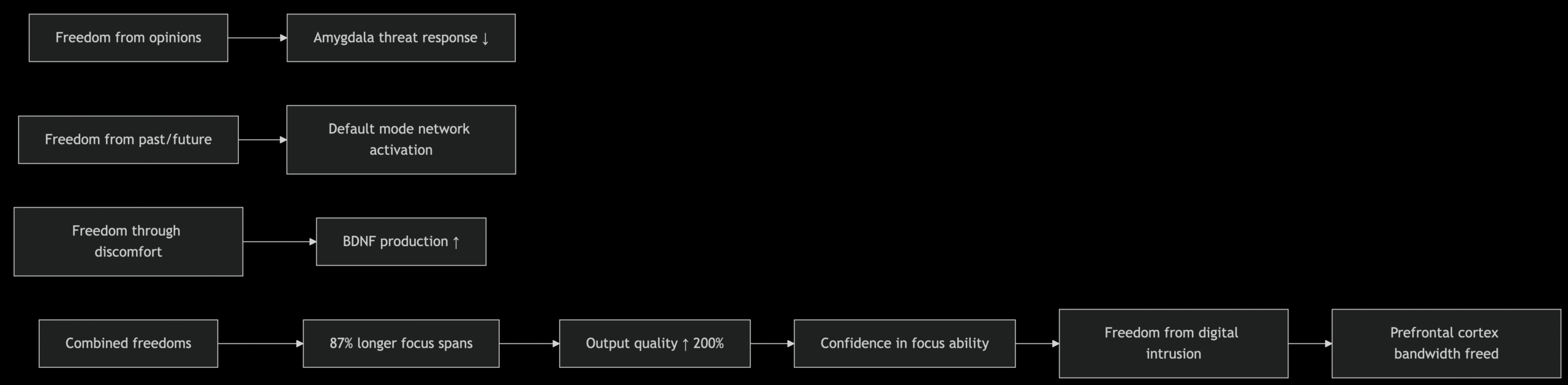
The Freedom → Focus Flywheel (Neuroscience-Backed)
Battle-Tested Focus Forging Framework
- Monday Freedom Audit
- Track attention leaks with RescueTime
- Delete 3 time-sucking apps (replace with focus tools like Brain.fm)
- Create “focus fuel zones” in environment (red lamp = do not disturb)
- Wednesday Discomfort Training
- 75-minute deep work session in colder environment
- Work standing up for 30-minute intervals
- Use cold exposure (ice facial plunge pre-work)
- Friday Mental Declutter
- Process inbox to zero using “freedom folders” system
- Conduct “opinion autopsy” – whose voices influenced you unnecessarily?
- Burn written record of past week’s regrets
Freedom isn’t the reward – it’s the ignition system.
When you strategically dismantle attention thieves, focus stops being exhausting and starts generating its own energy. The most productive people don’t have more willpower – they’ve engineered freedom ecosystems where concentration becomes inevitable.
“The capacity to maintain focus for extended durations is the extraordinary skill of the 21st century. Its driving force is complete freedom..”
– Dr. Amishi Jha, Neuroscientist
Author of Peak Mind: Find Your Focus, Own Your Attention
Your freedom assignment today:
Identify ONE attention colonizer in your life. Execute it with extreme prejudice before sunset. Notice how focus rushes into the newly liberated territory.
References from cognitive science leaders: